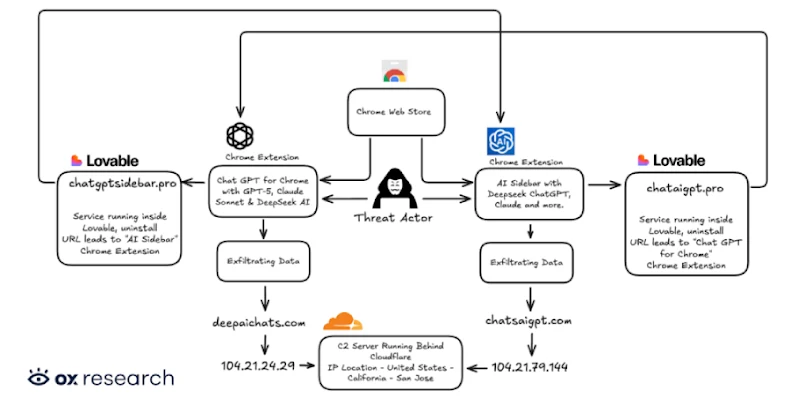
Cybersecurity researchers have discovered two new malicious extensions on the Chrome Web Store that are designed to exfiltrate OpenAI ChatGPT and DeepSeek conversations alongside browsing data to servers under the attackers’ control.
The names of the extensions, which collectively have over 900,000 users, are below –
- Chat GPT for Chrome with GPT-5, Claude Sonnet & DeepSeek AI (ID: fnmihdojmnkclgjpcoonokmkhjpjechg, 600,000 users)
- AI Sidebar with Deepseek, ChatGPT, Claude, and more. (ID: inhcgfpbfdjbjogdfjbclgolkmhnooop, 300,000 users)
The findings come weeks after Urban VPN Proxy, another extension with millions of installations on Google Chrome and Microsoft Edge, was caught spying on users’ chats with artificial intelligence (AI) chatbots. This tactic of using browser extensions to stealthily capture AI conversations has been codenamed Prompt Poaching by Secure Annex.
The two newly identified extensions “were found exfiltrating user conversations and all Chrome tab URLs to a remote C2 server every 30 minutes,” OX Security researcher Moshe Siman Tov Bustan said. “The malware adds malicious capabilities by requesting consent for ‘anonymous, non-identifiable analytics data’ while actually exfiltrating complete conversation content from ChatGPT and DeepSeek sessions.”
The malicious browser add-ons have been found to impersonate a legitimate extension named “Chat with all AI models (Gemini, Claude, DeepSeek…) & AI Agents” from AITOPIA that has about 1 million users. They are still available for download from the Chrome Web Store as of writing, although “Chat GPT for Chrome with GPT-5, Claude Sonnet & DeepSeek AI” has since been stripped of its “Featured” badge.
Once installed, the rogue extensions request that users grant them permissions to collect anonymized browser behavior to purportedly improve the sidebar experience. Should the user agree to the practice, the embedded malware begins to harvest information about open browser tabs and chatbot conversation data.
To accomplish the latter, it looks for specific DOM elements inside the web page, extracts the chat messages, and stores them locally for subsequent exfiltration to remote servers (“chatsaigpt[.]com” or “deepaichats[.]com”).
What’s more, the threat actors have been found to leverage Lovable, an artificial intelligence (AI)-powered web development platform, to host their privacy policies and other infrastructure components (“chataigpt[.]pro” or “chatgptsidebar[.]pro”) in an attempt to obfuscate their actions.
The consequences of installing such add-ons can be severe, as they have the potential to exfiltrate a wide range of sensitive information, including data shared with chatbots like ChatGPT and DeepSeek, and web browsing activity, including search queries and internal corporate URLs.
“This data can be weaponized for corporate espionage, identity theft, targeted phishing campaigns, or sold on underground forums,” OX Security said. “Organizations whose employees installed these extensions may have unknowingly exposed intellectual property, customer data, and confidential business information.”
Legitimate Extensions Join Prompt Poaching
The disclosure comes as Secure Annex said it identified legitimate browser extensions such as Similarweb and Sensor Tower’s Stayfocusd – each with 1 million and 600,000 users, respectively – engaging in prompt poaching.
Similarweb is said to have introduced the ability to monitor conversations in May 2025, with a January 1, 2026, update adding a full terms of service pop-up that makes it explicit that data entered into AI tools is being collected to “provide the in-depth analysis of traffic and engagement metrics that you expect by using the Service.” A December 30, 2025,